- ZHUHAI JIALI HARDWARE CO.,LTD.
- 0760-85885164

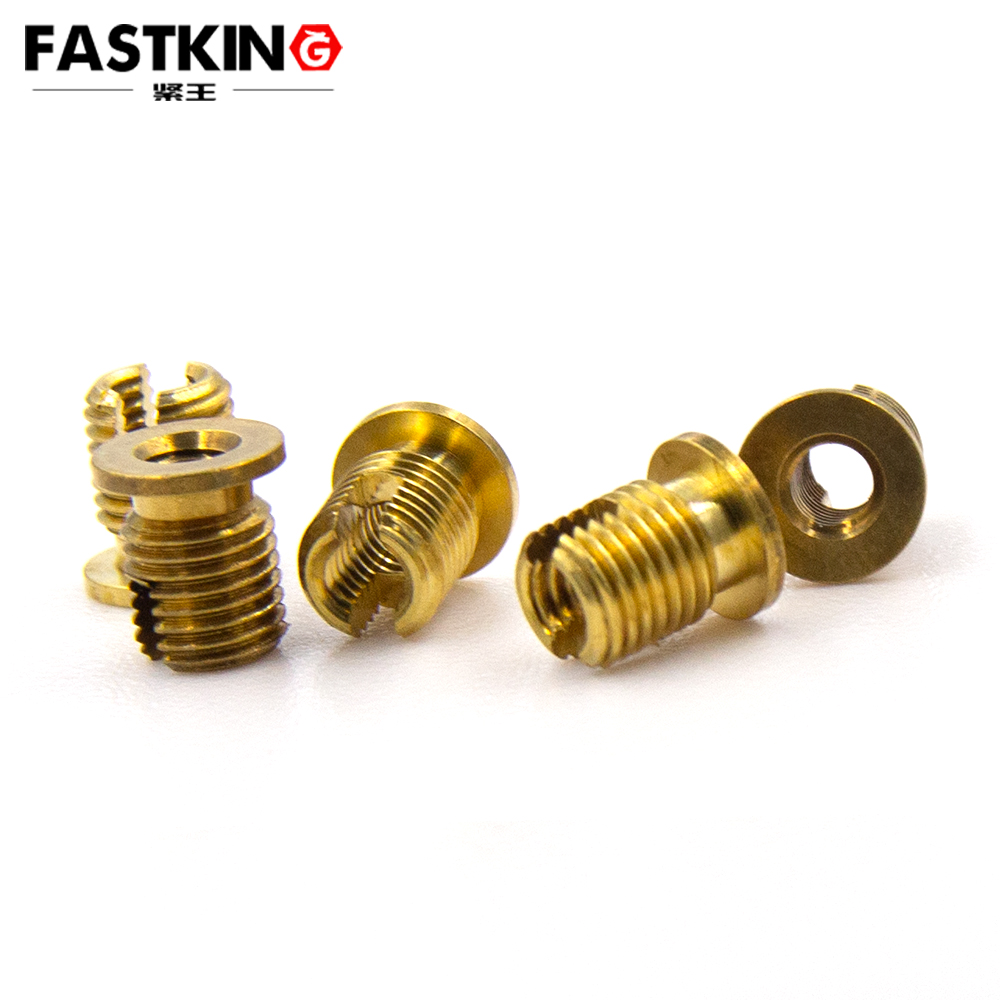
Slotted brass screw

- Product description:In the field of precision manufacturing and assembly, straight brass screws and slotted flange self-tapping inserts (internal and external thread self-tapping inserts) are key fasteners that enhance t
I. Core Product Features
Slotted Brass Machine Screw
Made from C3604 brass with a straight slotted head design, it is suitable for installation with manual or electric screwdrivers. It features high electrical and thermal conductivity, non-magnetic properties, oxidation resistance and excellent machinability. With high-precision threads, it is ideal for precision assembly and commonly used in conductive connections, grounding fixation and light-load fastening applications.
Slotted Flange Self-Tapping Inserts (Internal-External Thread Inserts)
Structure: Dual internal and external thread design; the external thread is equipped with slotted cutting edges, and the tail is fitted with a flange. The slots enable self-tapping cutting, while the flange increases contact area and improves pull-out resistance and anti-vibration performance.
Material: Mainly made of brass, suitable for soft base materials such as plastics and aluminum alloys. It can be directly screwed into a pre-drilled hole to form high-strength internal threads without pre-tapping, solving problems such as thread stripping and insufficient thread strength in soft materials.
Advantages: High installation efficiency, 3–5 times higher pull-out resistance, anti-loosening and anti-vibration performance, repairability for damaged threads, suitable for mass production and maintenance scenarios.
II. Standard Installation Methods
Installation of Slotted Brass Screws
- Preparation: Drill a properly sized pilot hole in the base material (brass screws do not require tapping; they can be directly driven into soft materials, while shallow threads may be lightly tapped in hard materials).
- Positioning: Align the slotted head with the screwdriver and keep it perpendicular to the base material surface.
- Fastening: Rotate clockwise using manual or power tools, controlling torque to avoid thread stripping. Ensure full thread engagement in conductive applications for reliable contact.
Installation of Slotted Flange Self-Tapping Inserts (Two Methods)
Method 1: Simple Installation (Small Batches / Maintenance)
- Take a bolt and nut of the same specification, place the insert onto the bolt, and lock them together with the nut.
- With the slotted end facing downward, align the insert with the pre-drilled hole and screw it in clockwise with a wrench until the flange is flush with the base material.
- Unscrew the bolt counterclockwise to complete installation. No special tools are required.
Method 2: Installation with Special Tools (Mass Production)
- Clamp the insert with a special installation tool, slotted end downward, and align vertically with the pilot hole.
- Drive steadily clockwise using electric or pneumatic tools to avoid tilting. Do not reverse after the insert enters 1/3 depth to prevent thread damage.
- Once the flange is fully seated, withdraw the tool counterclockwise to finish installation, improving efficiency by more than 50%.
Key Installation Notes
- Pilot hole size must strictly match specifications; slightly enlarge holes for hard materials and follow standards for soft materials.
- The insert must be installed with the slotted end downward to ensure smooth cutting and chip removal.
- Tilted installation is prohibited to avoid thread breakage. The flange must be fully seated to ensure clamping force.
III. Core Application Scenarios
1. Electronics and Electrical Industry
- PCB Circuit Boards: Brass screws secure components and provide grounding connections to shield against electromagnetic interference. Self-tapping inserts reinforce the connection between PCBs and plastic enclosures, preventing thread stripping in plastics.
- Power Supplies / Distribution Cabinets: Brass screws fix terminal blocks with low resistance loss. Self-tapping inserts are used for insulating partitions and module mounting, resisting humid and dusty industrial environments to ensure electrical safety.
- Communication Equipment: RF modules and antennas are fixed with brass, which is non-magnetic and does not interfere with signals. Self-tapping inserts provide anti-loosening and anti-vibration performance for outdoor base station applications.
2. Household Appliances and Smart Home
- Refrigeration Equipment (Air Conditioners / Refrigerators): Brass screws secure compressor circuit modules and assist heat dissipation. Self-tapping inserts embedded in plastic housings improve connection strength for long-term vibration environments.
- Smart Locks / Security Cameras: Brass screws fix internal circuits and housings for anti-theft and tamper resistance. Self-tapping inserts withstand outdoor rain and ultraviolet radiation for long-term stability.
-
Luminaires / Switches and Sockets: Brass screws provide conductive connections to ensure electrical safety. Self-tapping inserts enhance assembly efficiency for plastic bases.
3. New Energy and Automotive Industry
- Photovoltaics / Energy Storage: Brass screws connect PV modules and battery packs with low-loss conductivity. Self-tapping inserts in plastic housings of inverters and junction boxes resist outdoor temperature changes and salt spray for reliable connections.
- New Energy Vehicles: In battery management systems and motor controllers, brass screws secure high-voltage terminals with high temperature resistance and fatigue resistance. Self-tapping inserts strengthen threads in plastic components to withstand vehicle vibration.
4. Machinery and Automation
- Precision Instruments / Medical Devices: Brass is non-magnetic and does not interfere with testing. Self-tapping inserts enable micron-level positioning and adapt to disinfection environments, ensuring accuracy and safety.
- Automated Production Lines: Self-tapping inserts are used for sensor and actuator installation. The hexagonal structure allows quick tightening to improve maintenance efficiency. Brass is oil-resistant and easy to clean.
5. Other High-End Applications
In aerospace and shipbuilding, brass self-tapping inserts are lightweight, high-strength, and resistant to extreme temperatures and salt spray, ensuring stable connections. In furniture and building materials, they fasten plastic and wooden parts to improve assembly quality and durability.
IV. Summary
Slotted brass screws and slotted flange self-tapping inserts combine brass material with a self-tapping structure to perfectly solve connection challenges in soft base materials. They retain the advantages of brass, including conductivity, corrosion resistance and non-magnetic properties, while achieving “no pre-tapping, high locking strength and easy installation” through self-tapping inserts, greatly improving production efficiency and product reliability.
From precision electronic assembly to outdoor new energy applications, from small household appliances to high-end equipment, these two components embody the value of “small parts, big roles” and have become indispensable core elements in the modern industrial connection system, providing solid support for the high-quality development of various industries.
